The Tower of London & Scotland Yard

Since my hotel was next to the Thames, it was a short walk along the river to Westminster Pier. I set out right after breakfast and was surprised to see several police officers in front of my hotel and all along the way to the pier. They smiled at me, so I wasn’t too concerned. I didn’t seem to concern them either. Maybe there was someone famous or royal in the area. From what I learned later, it might have been different if I had headed towards Whitehall instead of staying along the Embankment.

At Westminster Pier, I bought a round-trip boat trip ticket to the Tower of London along with the admission ticket to the Tower. It was a savings to get the package. Also, I wouldn’t have to stand in line to buy a ticket once I got to the Tower. I just needed to exchange the voucher I was given, which was a much shorter line.

Along the way, I took a few photos – especially of the places I couldn’t take photos of the previous year due to the heavy rain when I was on the river. The Globe Theatre was one of them. This time I sat on the open upper deck of the boat where I could see both sides of the river quite well.

There were really large crowds at the Tower when I arrived, including all of us that had been on the super crowded boat. I guess I picked the same day to go to the Tower as everybody else in London. This was my first time back to the Tower since 2003 – fourteen years.

The White Tower was built in 1078 and the general layout of the entire complex has been in existence since the 13th century, renovated during the reign of Henry III (the same guy who rebuilt so much of Westminster Abbey). In the years that I have visited the Tower, there have been different towers open and different exhibits and changes in location of some of the items they keep there. I was given a map to the Tower complex along with my ticket and noticed that there were several more changes from when I was last there.

To enter the Tower, it was necessary to open my nylon bag in which I carried my camera, map and other items for inspection by one of the Yeoman Warders (aka Beefeaters). Since being a Yeoman Warder is a reward for retired service members who had excellent records and some retired service people are now women, I experienced some female Yeoman Warders on this trip for the first time. The one who looked through my bag, jokingly tried to pocket the Cadbury hazlenut chocolate bar I had in there (along with a granola bar).

I think I have mentioned before that I am not a huge fan of large crowds and tend to do whatever I can to avoid them when possible. So, when I saw the masses grouped around a Yeoman Warder who had his back to Traitor’s Gate, I decided to forego the Yeoman Warder tour this time (as wonderfully entertaining as it is) and went up the stairs to the St Thomas Tower. The photo I have of the crowd was taken from the top of the stairs just before I entered that tower.

St Thomas Tower, which is the half-timbered structure over the Traitor’s Gate, had never been open any of the other times I had been there from 1983 to 2003. By 2017, the bedchamber had been restored to what they believed it looked like under Edward I (who built that tower). There was also a display showing how the walls were constructed in the Hall (a large room where the King could dine and entertain).

I crossed a small arch connecting the St Thomas Tower with the Wakefield Tower (built by Henry III) while allowing people to pass underneath down on the pavement between the outer wall and inner wall. An audience chamber from the time of Edward I had been recreated in the Wakefield Tower. This too was new. The throne was based on the Coronation Chair in Westminster Abbey and was painted to look like it might have looked in the 13th century. In the private chapel just off of the audience chamber, King Henry VI was murdered in 1471. When the Wakefield Tower had been open on prior visits, it had been stark and empty.

The St Thomas, Wakefield and Lanthorn Towers are all that is left of the Royal Apartments. From the Wakefield Tower I came out onto the walls between the outer ward and inner ward for the wall walk. Some of the remaining ruins of the rest of the Royal Apartments could be seen on the grounds of the innermost ward.

On the wall walk, I passed through the Lanthorn, Salt, Broad Arrow, Constable, Martin, Brick, Bowyer, and Flint Towers. The walk ended at the Devereux Tower near the Chapel. When I was there before, it had ended at the Martin Tower. Back in 1983, the wall walk had consisted of coming out of the Bloody Tower and down the stairs.

As I walked along the walls, down below, I could see medieval tents, costumed interpreters from several eras, and sculptures of some of the animals that had lived there when the Tower had a zoo. They didn’t have all that when I was last there. They also didn’t have any place to eat or any gift shops within the Tower precincts before.

Between the Martin Tower and the Brick Tower, I could look down at the fronts of some of the Yeoman Warder houses built against the outer wall in the outer ward. One thing about living at the Tower, they are there at night when all of the tourists are gone and the ghosts remain. Some of them have related some pretty scary stories over the years.

When I came down from the wall at the Devereux Tower, I walked out to the Tower Green. This was where the executions of people who they wanted to keep out of public view took place. They were beheadings. More public executions of prisoners at the Tower (beheadings or hangings) took place outside of the walls on Tower Hill. These were still royal or noble persons, not regular people.

Beauchamp Tower had much more of it open and contained displays. It is known for its graffiti by the many prisoners it had housed over the centuries, especially the 15th and 16th centuries. The one that I have always found poignant was Lady Jane Grey’s name scratched into the wall by her husband, Lord Guilford Dudley, shortly before they were both executed. She was only 17 and he was not that much older. The Beauchamp Tower was also where Lady Rochford, Henry VIII’s 5th wife Catherine Howard’s Lady in Waiting, was imprisoned. Lady Jane Grey and Lady Rochford were both buried in the Chapel.

After visiting the Beauchamp Tower, I went for some lunch at a spot between the Wakefield and Lanthorn Towers facing the innermost ward and the White Tower. I had an enormous smoked bratwurst with mustard and onions. There were a couple other lunch spots to sit down indoors and have more of a sit down meal. But it was a lovely day and I thought sitting outside would be preferable.

After lunch, I visited a display of torture devices in the lower part of Wakefield Tower. Other times when I had been there, they had exhibited the rack in the lower part of the Martin Tower. The lower portion of Wakefield Tower had not been open to the public then. Afterwards, I climbed the steps to the Bloody Tower.

Before entering the Bloody Tower, I took a photo of Traitor’s Gate with the St Thomas Tower above it through the arch of the Bloody Tower. The portcullis of the Bloody Tower can also be seen in the photo. Once inside, I took a shot of the rest of the portcullis.

The Bloody Tower is famous partly for housing Sir Walter Raleigh for several years (1603 – 1616). His room was still furnished as it had been every other time I had been there.

The Bloody Tower’s other claim to fame is the mystery of the Princes in the Tower. The room where the two children had supposedly been imprisoned was no longer furnished. It was just bare this time. I think it is because they really don’t know for certain where the princes were kept.

The bones of two children were discovered beneath the stairs leading to the White Tower back in 1647 and were reburied at Westminster Abbey in the chapel where Elizabeth I was also buried. They had gone missing, while under their Uncle Richard III’s care, in 1483.

On my way to climb the stairs to the White Tower, I encountered a female Yeoman Warder chatting with a knight in chainmail. The Yeoman Warders have been in existence since the time of Henry VIII, but the knight was definitely from a much earlier era.

The White Tower was chock full of stuff. Before, much of it had been sparsely decorated with a few suits of armor – notably one owned by Henry VIII – and a few scattered others. The Line of Kings (dating from the 17th century) had been refurbished. This consists of carved wooden horses accompanied by the armors of numerous kings. I had never seen them all before.

The Chapel of St John, which had always been bare, was decorated and furnished, but no photos were allowed. Every floor had loads of items, including an amazing amount of armor, and weapons (swords, daggers, bows, guns, spears, axes, mace, cannons).

After a parting photo of Traitor’s Gate, I headed for the boat to return to Westminster Pier. At the boat I was told that Westminster Pier was closed due to high tide and rough waves. They suggested that I go to Greenwich instead. The boat would be there for about a half hour, by which time it would be okay to go to Westminster Pier. By the time we got to Greenwich, it was raining heavily, so I just stayed on the boat and went through the photos I had taken that day on both my camera and my phone.

Roughly a block from my hotel, along the river, is Scotland Yard. As I went by to return to my hotel, I could see loads of police officers with automatic weapons drawn. There were also loads of television cameras. I didn’t think it would be a good idea to whip out my camera or phone, so I just walked on by as unobtrusively as possible.

It turned out that the real reason the boats weren’t going to Westminster Pier earlier was because Scotland Yard was involved in the take down of a terror suspect on Whitehall close to 10 Downing (the Prime Minister’s residence and offices). He was then taken to that particular building where he was being held. Both Whitehall and the Embankment had been shut down and were just reopened shortly before they let the boats return to the pier. It was all on the BBC that night.

Next time – first part of a Heart of England & Wales tour with Rabbie’s

London: Banqueting House, Westminster Abbey & Temple Church

Banqueting House is the last remaining portion of Whitehall Palace. King Charles I stepped from one of the windows to a scaffold to be beheaded in 1649. His son, Charles II returned from exile and took up residence in 1660. Westminster Abbey is over 1,000 years old – the scene of every coronation since William the Conqueror, and the last resting place of over 3,300 people, including 17 monarchs. Temple Church was built by the Knights Templar in 1185 and is the burial place of several knights, including three of my ancestors.

Originally I was to go on a day tour to Stonehenge and Salisbury on this particular Thursday and just hang out in London to visit these locations the following day. But I received an email from the tour company the day before saying that the Stonehenge & Salisbury tour had been canceled. Did I want to go to Stonehenge, Avebury and Glastonbury on the Friday? I just switched plans for the two days (fortunately I didn’t have another tour booked for Friday and hadn’t booked ahead for the Abbey).

After breakfast, I sauntered down the Strand to Whitehall and Banqueting House. I was slightly ahead of schedule and so had to wait just outside the door until they opened. Designed by Inigo Jones and completed in 1622 at the behest of King James I/VI as an addition to Whitehall Palace, Banqueting House was part of another palace that Henry VIII took from Cardinal Wolsey (called York Place) and greatly enlarged.

The rest of Whitehall Palace burned down in 1698, by which time the king was the widowed William III, whose heart just wasn’t in having it rebuilt. His wife, Mary II, had been the granddaughter of Charles I (and daughter of James II/VII). Had she still been alive, it would have been rebuilt.

The ceiling of Banqueting House was commissioned by Charles I and painted by Peter Paul Rubens. The paintings were done in Rubens’ studio and installed in the specially designed frames on the ceiling in 1636.

Charles I was disappointed when Rubens went back to Antwerp when he was done and left Anthony van Dyck behind in his place to be the court painter. He wasn’t disappointed for long as van Dyck quickly proved his own talents. The artist was knighted by Charles and preceded him in death by eight years. He was buried at Westminster Abbey.

The glorious ceiling paintings, pretty much deifying his father, most likely would have been the last things Charles would have seen before stepping out of the window from that room to the scaffold. Actually, they used to say that he stepped from one of the windows from the room itself (the far right window in the photo I have included here). Now they say he stepped from a window that used to be above what is now the entrance to the building. Either way, it is said that he wore two shirts because it was cold and he didn’t want people to think he was shivering with fear.

Shortly after leaving Banqueting House, when heading south on Whitehall, the street becomes Parliament Street, which then empties into Parliament Square. Once in Parliament Square, facing east is a great view of the Palace of Westminster, aka Parliament. Several statues of mostly Prime Ministers stand around the square. But there are a couple of non-Prime Ministers there too. Looking west across the street, you will find Abraham Lincoln and, just before crossing the street to go to Saint Margaret’s Church, you can see Nelson Mandella.

Originally built in the 12th century and rebuilt in the early 16th century, St Margaret’s has been the site of several wedding over the centuries, including John Milton, Samuel Pepys, and Winston Churchill. This St Margaret is not the one from Scotland, but a 4th century martyr from Antioch. There is also a St Margaret of York and a St Margaret of Cortona.

In the church is a window commemorating Henry VIII’s marriage to Catherine of Aragon. Sir Walter Raleigh, executed across the street in Old Palace Yard, is among those buried here. Another window shows him in happier times with Queen Elizabeth I and Edmund Spenser, the poet who wrote The Faerie Queen.

Next to St Margaret’s is the visitor’s entrance to Westminster Abbey. I had to stand in line for a bit, but it wasn’t really too bad. I have experienced longer lines before and since. I was buying my ticket there instead of in advance online. With the online advance ticket, there is a special “skip the line” entrance. To get the advance ticket, it is necessary to specify a particular time slot. I didn’t want to do that on this trip to stay a little more flexible. So I took my chances with the line.

Westminster Abbey is one of my favorite places. I visit pretty much every time I am in London. It is amazing and overwhelming at the same time. Some people have asked in the past why I go to see a place I have been to before. I’ve already seen it; why would I want to see it again?

One answer is that it might have been a very long time ago that I saw it and my memories are fuzzy (not the case with Westminster, but it had been 13 years since I saw it last). Another answer is that, with a place that I find fascinating, I can see things and experience things that I have never seen or experienced before. Then there is that fact that things change. How can an over 1,000 year old church change? You’d be surprised.

The coronation throne used to sit behind the Shrine of Edward the Confessor. It could be easily missed there unless one knew to look for it or had a guide point it out. By 2016, it was up in the front of the abbey in its own special room. The portrait of King Richard II (the fella I had seen David Tennant portray onstage in NYC at the beginning of this trip), was now just outside of where the throne sat. Richard is seated in that throne in the portrait, which used to be just inside of the entrance to the Royal Chapels. There, loads of people missed out on seeing him. The portrait is pretty cool. It was painted in 1390 at Richard’s request and therefore should be a pretty accurate portrayal.

Unfortunately, photography is not allowed inside of the abbey, so I can’t include a photo that I took of the painting However, I have included an official photo of it from the abbey’s website. He was only ten years old when crowned King of England. His father had died a year earlier, so he succeeded his grandfather, Edward III in 1377. He was deposed in 1399 by Henry Bolingbrooke (King Henry IV) and subsequently murdered while in captivity. He was 33.

Another change was that Westminster Abbey now had audio guides. The audio guide had numbers on it that corresponded to numbers on a map. No more crowding around a guide or trying to squeeze past a crowd.

The special floor in front of the altar had been uncovered as well. Previously this floor had been covered over for centuries and only visible for coronation ceremonies and rare special viewings.  It has a type of inlaid stone called Cosmati and was installed by Henry III in 1268.

Founded in 960 AD by King Edgar and Saint Dunstan, the official name of the abbey is the Collegiate Church of Saint Peter at Westminster. It is a “Royal Peculiar”, which means it falls under the direct jurisdiction of the reigning monarch. Various monarchs have made their marks on Westminster Abbey, most notably King Henry III, whose building spree in 1245 made it largely what is seen today. King Henry VII built the Lady Chapel with the magnificent fan vaulted ceiling in 1503.

In 2016, the abbey was in the process of creating a whole new space for its museum in galleries up above the abbey’s nave that would be opened in 2018. That particular area of the abbey had not been open to the public for 700 years.

I spent a couple of hours at Westminster Abbey, exploring it more thoroughly than I had ever been able to do so before. The exception was the Shrine of Edward the Confessor. It was off limits. It used to be open to a few people at a time, but things change.

I discovered after I got back home that there were Verger tours open at specific times on specific days. A Verger (who is basically a church caretaker) takes a small group of people into places of the abbey where tourists cannot go on their own, including the Shrine of Edward the Confessor. I decided the next time I traveled to London, I would arrange for a Verger tour.

Another change was that they now had a restaurant within the abbey. It was in the former food stores of the monks in the 14th century and is called the Cellarium Café. I had some Welsh Rarebit (a fancy cheese toast) with salad, and an apricot tart with ice cream.

My foot was bothering me (the same one which had a stress fracture back in 2014), so I took a taxi back to the hotel (there were several parked out in front of the abbey), gave my foot a massage and wrapped it in an ace bandage. Once wrapped, it felt much better.

I decided I didn’t need to stay in the room with my foot elevated, but I didn’t want to go too far. So I walked the relatively short distance from the hotel to Temple Church.

Built in 1185 by the Templar Knights, the original part of the church is round, with a later rectangular addition. I have mentioned in past posts that I have loads of ancestors who were knights. Two became Templar Knights in their later years. They were buried in the crypt of the church with effigies upstairs.

One died in 1219 at the age of 73. He was a knight all of his life and even led (and won) a major battle at the age of seventy. He had served five kings – Henry II, his sons, the “Young King” Henry, Richard I, John and John’s son, Henry III. He decided to become a Templar Knight on his deathbed and was invested into the order.

Another died in 1226 at the age of 56. He came to the Templars a little later in life — in 1212 at the age of 42. He had been a busy guy – also in the service of Richard I, John and Henry III. He was a strong supporter of the Templars with gifts of lands in Yorkshire. So, as a generous member of the order, he was honored with burial at Temple Church.

Another ancestor died while on crusade in the Kingdom of Jerusalem in 1241 (at the age of 31). He was with Richard of Cornwall, who was King John’s second son and was involved with the refortification of Ascalon. A chunk of stone, found among the rubble in a former moat in Ascalon, had graffiti including this particular ancestor’s coat of arms. He is also buried in the Temple Church. He either doesn’t have an effigy, or his is one of the unidentified effigies, or his was destroyed when the church was bombed by the Germans during World War II. His body is down in the crypt somewhere.

Next time – Mystic locations of Stonehenge, Glastonbury, and Avebury

Train from Edinburgh to London & Boat Ride to Greenwich

The Virgin Trains East Coast train from Edinburgh’s Waverly Station to London’s Kings Cross Station was leaving at 10:00am. After having breakfast and checking out of the hotel, I asked the Doorman on duty about the best way to get from the hotel to the train station. Although it was next door, there was a shopping mall in between. Should I go through the mall? Should I go past the mall and around the corner? He started telling me the way to get there (neither of those two) and then decided he would just take me there himself.

He told the other Doorman on duty inside, took hold of my bags, and escorted me to just past the mall entrance next to the hotel to some steps to the roof of the mall. That was a surprise. When we got to the end of the mall roof near the station, there was an elevator. This took us down into the train station. My new friend (he was actually from Romania – a combination Romanian and Scottish accent is quite delightful) led us to the Departures board, found the train I would be riding, and then took me and my bags to another elevator.

That elevator took us to where the trains themselves were waiting. He continued to escort me all the way to the train. There he made sure I got my larger bag checked. I was traveling First Class (I had gotten a great deal there too). In Standard you keep your bags and try to find a place to put them, which may or may not be near you. Once the bag was checked, he turned me over to the First Class Conductor. Needless to say, I gave the Doorman a good tip.

I had booked a single seat that was at a table. I placed my coat in the rack above me, the small bag on the floor under the table, and settled in. The trip took four hours, stopping at various towns and cities along the way. Lunch was served, so I wasn’t hungry when I arrived at my destination.

Once in London, I checked into my hotel. It was a hotel I used to stay in with Mom on many trips. But it had recently undergone a total refurbishment, gained another star, and decided that their focus would be on the business traveler. I realized on this trip that it was no longer the hotel for me.

The next morning after I arrived, I walked down The Strand to take the boat from Westminster Pier to Greenwich. En route I took a photo of the Admiralty Arch with the UK flags lining The Mall beyond the arch. As I reached Westminster Pier, I took a photo of the statue of Boudica.

Boudica was queen of the Iceni tribe of Celtic Briton who led a revolt against the Romans in about 61 AD. Her husband, the king had died, leaving his kingdom split between his two daughters and the Roman Empire. His will was ignored. His daughters were raped. His widow publicly flogged.

 Boudica raised an army and went after the Romans in three cities – Verulamium (now St Albans), Camulodunum (now Colchester), and Londinium (now London). It is said that roughly 70,000 to 80,000 Romans and British were killed. All three cities were burned. London was where the Ninth Legion met Boudica’s troops and lost. But, there were way more Romans and they ultimately defeated the Britons.

Once on the boat, I took a photo of the London Eye before going inside. It was starting to look like it was going to rain. All along the boat ride down the Thames to Greenwich, I took as many photos as I could on the side of the boat where I sat. Humorous commentary was given onboard as various landmarks on either side of the boat were pointed out. I planned to sit on the other side on the way back.

As we glided beneath the Tower Bridge, I shot several photos as that bridge is a favorite of mine. I have included a photo with the modern building The Shard framed between the towers of the bridge.

Beyond both the Tower of London and the Tower Bridge and on the same side of the Thames as the Tower of London was the Prospect of Whitby. This was the oldest pub on the river, dating to about 1520. The current building is not original as it had a fire and was rebuilt in the early 19th century. The only part that is original is the stone floor.

A little further along, in the area known as Limehouse, is the Grapes, where Charles Dickens lived for a time in about 1820. The building dates from the 1720s. Another pub dating from 1583 was on the same site before it. The pub is currently owned by a trio of people including actor Ian McKellen. He lives a little further along the river near Canary Wharf.

When we reached Greenwich Pier, I immediately headed for the Royal Observatory. Mom and I had been to Greenwich on our first visit to London back in 1983, but had not made it up to the Observatory. We had spent most of our time there at the Queen’s House (built 1616-1635), which houses part of the National Maritime Museum.

The climb to the Observatory is a steep one and I knew it would take time. I often will explore whatever is the farthest or the most difficult to get to first when I am operating on my own agenda instead of someone else’s. There was a less steep, but longer walk that sort of wound around the hill. I decided to take that route up and the super steep route down.

The Royal Observatory was commissioned in 1675 by King Charles II and built by Sir Christopher Wren (the same guy who built St Paul’s Cathedral). The Royal Observatory is home to Greenwich Mean Time (from which all time around the world originates) and the Prime Meridian (zero meridian from which will all distances around the world are measured).

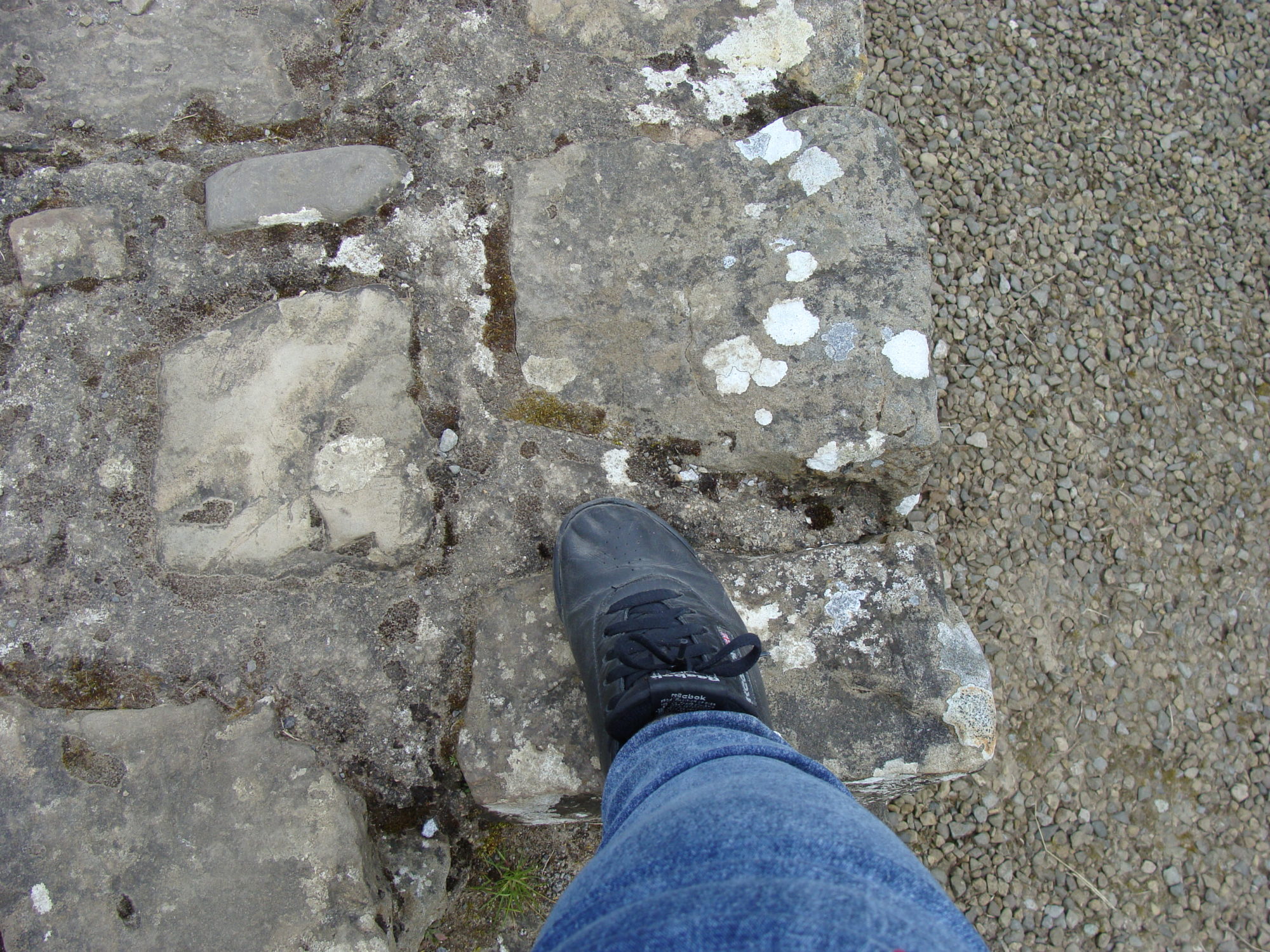
People like to get the cheesy photo with one foot on each side of the meridian line. I took an equally cheesy photo of my feet straddling the line – one in the eastern hemisphere and one in the western.

Once I had explored the building and the exhibits inside, took my feet photo, and spent as much time as I wanted up there, I headed back down, walking through the park that surrounds the space, and found a pub in which to have lunch. The Greenwich Tavern had the usual traditional pub fare, such as fish and chips, which was what I ordered, plus a half pint of cider.

Next came the Royal Naval College, created in the 19th century in a building built in the 17th century by Sir Christopher Wren as Greenwich Hospital, a home for retired sailors.

There are several connections between Greenwich and Admiral Horatio Nelson. He lied in state in the Painted Hall at what became the Royal Naval College before his funeral at St Paul’s Cathedral. Several items belonging to him, including the uniform he was wearing at the Battle of Trafalgar, are housed in the National Maritime Museum in the Queen’s House.

The Chapel in the Royal Naval College has, near the entrance, a memorial to Thomas Hardy, Captain of the HMS Victory during the Battle of Trafalgar (not the novelist). He was also a close friend of Nelson’s, and was with him when he died on the Victory after being shot by a French Sharpshooter. Hardy was a Governor of Greenwich Hospital near the end of his career.

The Cutty Sark was built in Scotland in 1869 as a tea clipper to China. It was later involved in the wool trade to Australia. The whiskey was named after the ship, which went into dry dock at Greenwich in 1954. Mom and I had toured the ship back in 1983. It suffered a pretty nasty fire in 2007 and was restored in 2012.

The name Cutty Sark comes from the nickname of the witch who chased Tam O’Shanter in Robert Burn’s 1791 poem. The ship was an extremely fast one back in its day. The restoration allows for visitors to seen beneath the ship as well and inside and on deck. I love ships, especially old ones, and I enjoyed getting to explore this one a second time.

On the way back to Westminster Pier, the rain came down really hard, making it impossible for me to take any photos beyond shortly after leaving Greenwich. My last photo shared here is of the Mayflower Pub in Rotherhithe.

In July of 1620, the Mayflower sailed from Rotherhithe to pick up more passengers in Southhampton and Plymouth, England, before sailing to what became Plymouth, Massachusetts. The Mayflower Pub claims to be at the site in Rotherhithe from which the Mayflower sailed. Whether or not that is true is up to discussion.

Back at Westminster Pier, the rain had stopped. As I walked up Whitehall towards The Strand, I took a photo near Banqueting House. Right after that, I saw that a ceremony was taking place at Horseguards Parade and crossed over to that side of the street to take a look. A photo is included here.

My last shot before heading up The Strand to my hotel was of Trafalgar Square, with the statue of Admiral Nelson on top of Nelson’s Column. The statue in front of the column is of King Charles I. The building seen behind the column with a dome is the National Gallery.

Next time – a day at Windsor Castle & Hampton Court Palace