I have never done a Hop On Hop Off Bus Tour in London before. I have always either walked, taken a bus or the Tube, or taken a taxi to where I wanted to go. But this time, since I have taken Hop On Hop Off buses many times in many other cities, I thought I would try it in London.
There is one problem I discovered with doing it in London. That is the combination of London being so large, with sites so spread out, so dense in population (and therefore slow-moving traffic), and so full of tourists. It takes a very long time to get anywhere.
I had also long wanted to do the London Eye, but always seemed to run out of time and energy before I got to it. Nowadays, however, it is necessary to prebook pretty much anything you want to do in London simply because of huge amounts of tourists. So I booked a ticket for the London Eye along with the Hop On Hop Off Two-Day Bus Tour Pass a few months before I went on this trip.
After breakfast, I walked a couple of blocks from the hotel to one of the stops for the Bus Tour. It was the Trafalgar Square stop and was located just outside of the Sainsbury Wing of the National Gallery. My ticket for the London Eye was at 11am. I was there in plenty of time. It turned out to be the first group of the day.
I very much liked the fact that I could move around in the capsule to be able to see and photograph what I wanted. In some ways, however, the ride seemed a little too short in length.
I also had a ticket for a one-way river cruise included with my Bus Tour. I took the bus to the Tower of London so I could ride back to Westminster Pier via boat. Whenever I am in a city with a river, I love to take a scenic boat ride. It gives me a nice relaxing ride and shows the city from a different perspective. This time I just managed to get on the boat before it departed. So wasn’t very near any windows. The large window at the front of the boat was somewhat streaked and dirty. So didn’t take a lot of photos.
At Westminster Pier, I got back on the Hop On Hop Off bus and rode it to the Victoria and Albert Museum. This was a museum I have visited on a couple of occasions on past trips to London. I was really looking forward to spending time there again. On both of my previous visits I had lunch in the museum’s café, which had been large and carried a good variety of food choices, which were quite good. This time, the location for the food was quite small, with little variety and not much seating room. The food itself was also disappointing.
The museum was also, unfortunately, a disappointment. The main problem was that there were no signs to direct a person anywhere or anybody to ask. I had printed out a floor plan while at home but found it difficult to follow as the rooms themselves weren’t numbered or labeled in any way. The museum itself did not provide any maps at all. They had a thick, heavy book for sale as a guide instead. When I did finally find someone who worked for the museum, she told me about her own frustration on the lack of information provided to visitors. I eventually gave up trying to find some of the areas I wanted to visit and left.
I got back on the Hop On Hop Off bus and rode it all the way back to Trafalgar Square. Still had another day to go with the Hop On Hop Off Tour and had plans for what I wanted to do.
Next time – Day Two of The Big Bus Hop On Hop Off Tour: Kensington Palace
Charing Cross Railway Station and BridgeRoyal Horseguards HotelA view of London with St Paul’s CathedralAnother view of Charing Cross Railway BridgeParliamentThe London EyeA new friendA sculpture at the V&ALyceum TheatreUnder London BridgeThe Millenium BridgeThe V&A Sculpture GalleryOne of the sculpturesA room in the V&A
The Virgin Trains East Coast train from Edinburgh’s Waverly Station to London’s Kings Cross Station was leaving at 10:00am. After having breakfast and checking out of the hotel, I asked the Doorman on duty about the best way to get from the hotel to the train station. Although it was next door, there was a shopping mall in between. Should I go through the mall? Should I go past the mall and around the corner? He started telling me the way to get there (neither of those two) and then decided he would just take me there himself.
He told the other Doorman on duty inside, took hold of my bags, and escorted me to just past the mall entrance next to the hotel to some steps to the roof of the mall. That was a surprise. When we got to the end of the mall roof near the station, there was an elevator. This took us down into the train station. My new friend (he was actually from Romania – a combination Romanian and Scottish accent is quite delightful) led us to the Departures board, found the train I would be riding, and then took me and my bags to another elevator.
That elevator took us to where the trains themselves were waiting. He continued to escort me all the way to the train. There he made sure I got my larger bag checked. I was traveling First Class (I had gotten a great deal there too). In Standard you keep your bags and try to find a place to put them, which may or may not be near you. Once the bag was checked, he turned me over to the First Class Conductor. Needless to say, I gave the Doorman a good tip.
I had booked a single seat that was at a table. I placed my coat in the rack above me, the small bag on the floor under the table, and settled in. The trip took four hours, stopping at various towns and cities along the way. Lunch was served, so I wasn’t hungry when I arrived at my destination.
Once in London, I checked into my hotel. It was a hotel I used to stay in with Mom on many trips. But it had recently undergone a total refurbishment, gained another star, and decided that their focus would be on the business traveler. I realized on this trip that it was no longer the hotel for me.
The next morning after I arrived, I walked down The Strand to take the boat from Westminster Pier to Greenwich. En route I took a photo of the Admiralty Arch with the UK flags lining The Mall beyond the arch. As I reached Westminster Pier, I took a photo of the statue of Boudica.
Boudica was queen of the Iceni tribe of Celtic Briton who led a revolt against the Romans in about 61 AD. Her husband, the king had died, leaving his kingdom split between his two daughters and the Roman Empire. His will was ignored. His daughters were raped. His widow publicly flogged.
Boudica raised an army and went after the Romans in three cities – Verulamium (now St Albans), Camulodunum (now Colchester), and Londinium (now London). It is said that roughly 70,000 to 80,000 Romans and British were killed. All three cities were burned. London was where the Ninth Legion met Boudica’s troops and lost. But, there were way more Romans and they ultimately defeated the Britons.
Once on the boat, I took a photo of the London Eye before going inside. It was starting to look like it was going to rain. All along the boat ride down the Thames to Greenwich, I took as many photos as I could on the side of the boat where I sat. Humorous commentary was given onboard as various landmarks on either side of the boat were pointed out. I planned to sit on the other side on the way back.
As we glided beneath the Tower Bridge, I shot several photos as that bridge is a favorite of mine. I have included a photo with the modern building The Shard framed between the towers of the bridge.
Beyond both the Tower of London and the Tower Bridge and on the same side of the Thames as the Tower of London was the Prospect of Whitby. This was the oldest pub on the river, dating to about 1520. The current building is not original as it had a fire and was rebuilt in the early 19th century. The only part that is original is the stone floor.
A little further along, in the area known as Limehouse, is the Grapes, where Charles Dickens lived for a time in about 1820. The building dates from the 1720s. Another pub dating from 1583 was on the same site before it. The pub is currently owned by a trio of people including actor Ian McKellen. He lives a little further along the river near Canary Wharf.
When we reached Greenwich Pier, I immediately headed for the Royal Observatory. Mom and I had been to Greenwich on our first visit to London back in 1983, but had not made it up to the Observatory. We had spent most of our time there at the Queen’s House (built 1616-1635), which houses part of the National Maritime Museum.
The climb to the Observatory is a steep one and I knew it would take time. I often will explore whatever is the farthest or the most difficult to get to first when I am operating on my own agenda instead of someone else’s. There was a less steep, but longer walk that sort of wound around the hill. I decided to take that route up and the super steep route down.
The Royal Observatory was commissioned in 1675 by King Charles II and built by Sir Christopher Wren (the same guy who built St Paul’s Cathedral). The Royal Observatory is home to Greenwich Mean Time (from which all time around the world originates) and the Prime Meridian (zero meridian from which will all distances around the world are measured).
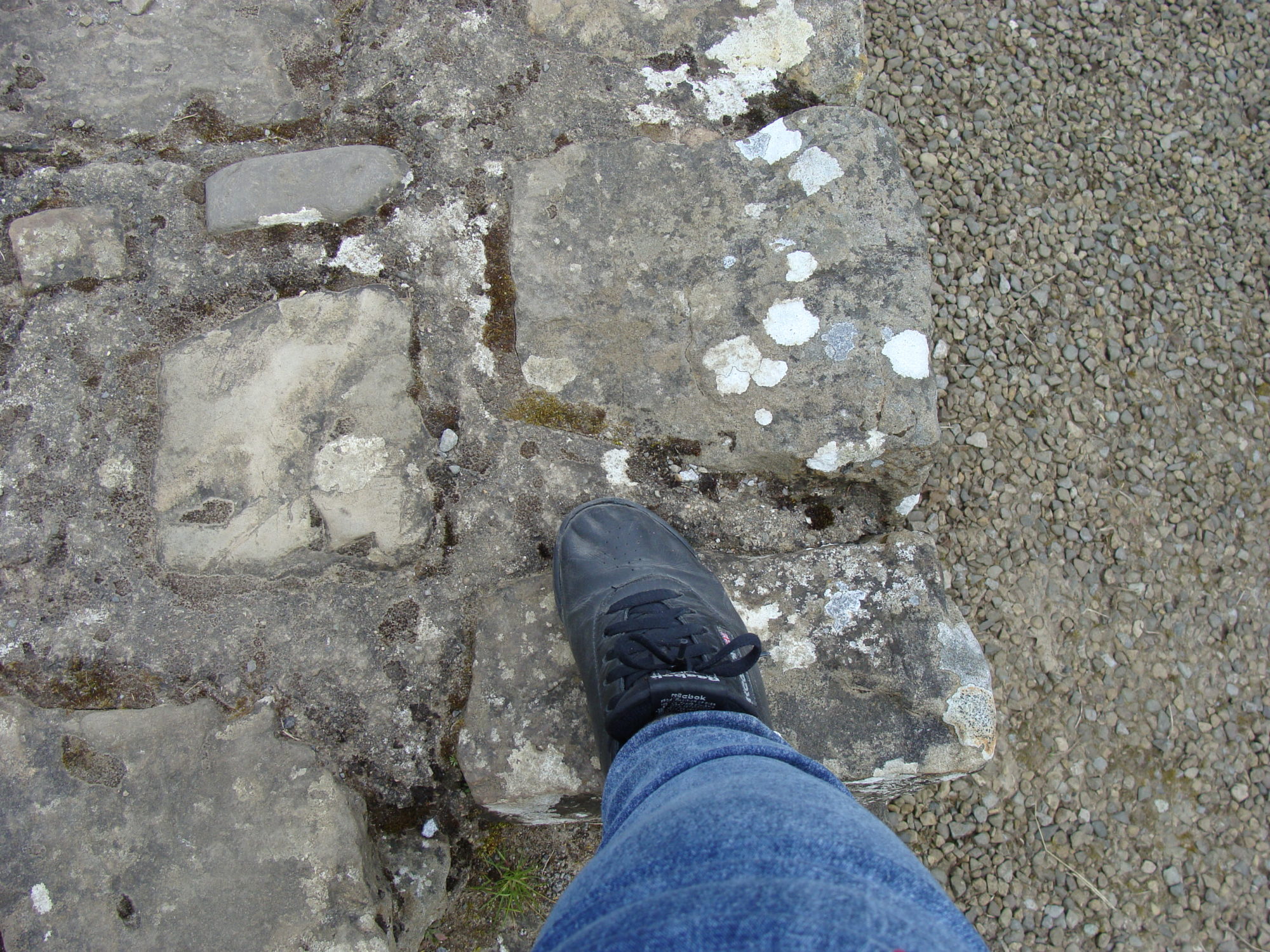
People like to get the cheesy photo with one foot on each side of the meridian line. I took an equally cheesy photo of my feet straddling the line – one in the eastern hemisphere and one in the western.
Once I had explored the building and the exhibits inside, took my feet photo, and spent as much time as I wanted up there, I headed back down, walking through the park that surrounds the space, and found a pub in which to have lunch. The Greenwich Tavern had the usual traditional pub fare, such as fish and chips, which was what I ordered, plus a half pint of cider.
Next came the Royal Naval College, created in the 19th century in a building built in the 17th century by Sir Christopher Wren as Greenwich Hospital, a home for retired sailors.
There are several connections between Greenwich and Admiral Horatio Nelson. He lied in state in the Painted Hall at what became the Royal Naval College before his funeral at St Paul’s Cathedral. Several items belonging to him, including the uniform he was wearing at the Battle of Trafalgar, are housed in the National Maritime Museum in the Queen’s House.
The Chapel in the Royal Naval College has, near the entrance, a memorial to Thomas Hardy, Captain of the HMS Victory during the Battle of Trafalgar (not the novelist). He was also a close friend of Nelson’s, and was with him when he died on the Victory after being shot by a French Sharpshooter. Hardy was a Governor of Greenwich Hospital near the end of his career.
The Cutty Sark was built in Scotland in 1869 as a tea clipper to China. It was later involved in the wool trade to Australia. The whiskey was named after the ship, which went into dry dock at Greenwich in 1954. Mom and I had toured the ship back in 1983. It suffered a pretty nasty fire in 2007 and was restored in 2012.
The name Cutty Sark comes from the nickname of the witch who chased Tam O’Shanter in Robert Burn’s 1791 poem. The ship was an extremely fast one back in its day. The restoration allows for visitors to seen beneath the ship as well and inside and on deck. I love ships, especially old ones, and I enjoyed getting to explore this one a second time.
On the way back to Westminster Pier, the rain came down really hard, making it impossible for me to take any photos beyond shortly after leaving Greenwich. My last photo shared here is of the Mayflower Pub in Rotherhithe.
In July of 1620, the Mayflower sailed from Rotherhithe to pick up more passengers in Southhampton and Plymouth, England, before sailing to what became Plymouth, Massachusetts. The Mayflower Pub claims to be at the site in Rotherhithe from which the Mayflower sailed. Whether or not that is true is up to discussion.
Back at Westminster Pier, the rain had stopped. As I walked up Whitehall towards The Strand, I took a photo near Banqueting House. Right after that, I saw that a ceremony was taking place at Horseguards Parade and crossed over to that side of the street to take a look. A photo is included here.
My last shot before heading up The Strand to my hotel was of Trafalgar Square, with the statue of Admiral Nelson on top of Nelson’s Column. The statue in front of the column is of King Charles I. The building seen behind the column with a dome is the National Gallery.
Next time – a day at Windsor Castle & Hampton Court Palace